
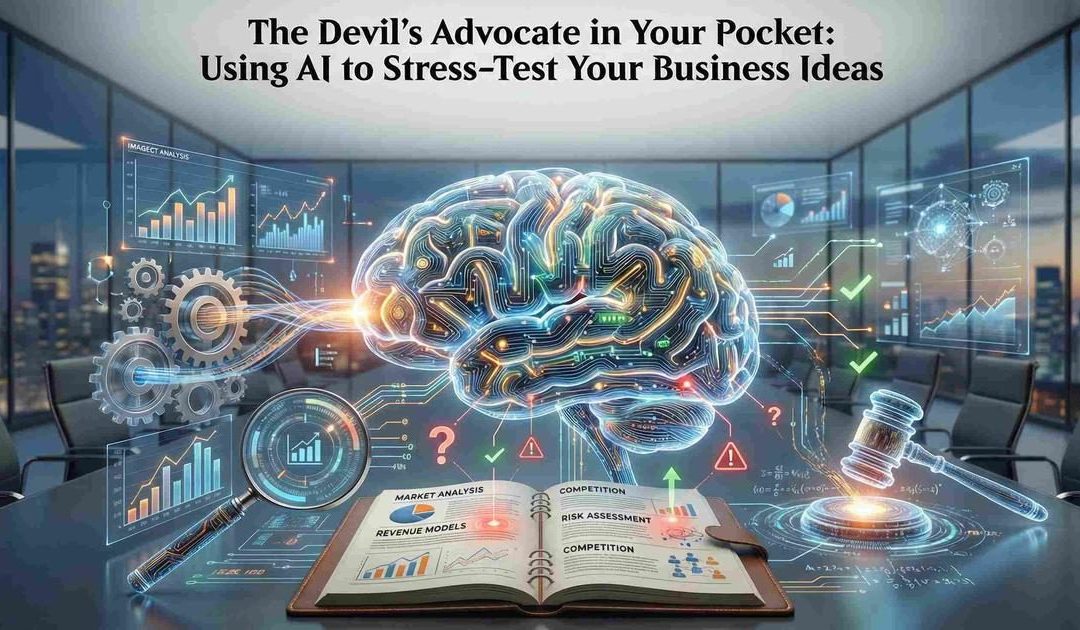
Are you confident your business idea will succeed? What if you are missing critical flaws? How often do you challenge your assumptions before investing resources?
These questions keep many business owners awake at night. The truth is, unchecked assumptions can lead to costly mistakes. Fortunately, AI offers a practical way to play the devil’s advocate for your business.
Why Challenging Your Business Ideas Matters
Every business idea rests on assumptions. You assume customers want your product, the market is ready, and competitors won’t outmaneuver you. But what if these assumptions are wrong? Blind spots can sink your plans before they launch.
Traditional methods rely on gut feeling or limited feedback. They often miss hidden risks or alternative perspectives. AI, however, can systematically test your ideas, revealing weaknesses and overlooked opportunities.
How AI Acts as Your Devil’s Advocate

AI tools process vast amounts of data quickly. They simulate scenarios, analyze market signals, and question your assumptions without bias. This creates a structured way to spot flaws and reduce risk.
Key Functions of AI for Stress-Testing Ideas
| Function | What It Does | Business Benefit |
| Data Analysis | Examines market trends, customer feedback, and competitor data | Identifies gaps and potential threats |
| Scenario Simulation | Tests different business outcomes based on variable changes | Prepares you for multiple possibilities |
| Assumption Checking | Flags unsupported or weak assumptions in your plan | Encourages evidence-based decisions |
| Sentiment Analysis | Gauges public opinion on your product or brand | Helps anticipate customer reactions |
Common Assumptions That AI Can Challenge
1. Customer Demand
You might believe your target audience is eager for your product. AI can analyze social media, reviews, and search trends to confirm or deny this. For example, sentiment analysis can detect if customers express frustration or enthusiasm around similar products.
2. Pricing Strategy
Setting prices can be guesswork. AI can compare competitor pricing, customer willingness to pay, and sales data to suggest optimal pricing models.
3. Market Entry Timing
Is now the right moment to launch? AI can track economic indicators and industry cycles to suggest if the market is favorable or saturated.
4. Competitor Response
Your strategy assumes competitors won’t react aggressively. AI simulations can predict competitor moves based on historical behavior and market conditions.
How to Use AI Tools to Stress-Test Your Ideas
Step 1: Define Your Assumptions Clearly
Write down the main assumptions in your business plan. For example: “Our product solves problem X for customer segment Y at price Z.”
Step 2: Select Relevant AI Tools
Choose AI platforms that offer data analysis, scenario modeling, or sentiment analysis. Some popular options include:
•Google Cloud AI for data insights
•IBM Watson for natural language processing
•Tableau with AI plugins for visual analytics
Step 3: Input Your Data and Assumptions
Feed your business data and assumptions into the AI tool. This may include market research, sales forecasts, or customer feedback.
Step 4: Review AI Output Critically
Look at what the AI highlights as weak points or risks. Pay attention to scenarios where your assumptions fail or where market signals oppose your plan.
Step 5: Adjust Your Strategy
Use the insights to refine your business model. This could mean changing pricing, targeting a different customer segment, or delaying launch.
Example: Stress-Testing a New Coffee Shop Idea
| Assumption | AI Analysis Result | Action Taken |
| Local market has high demand | Social media and search trends show limited interest | Shift to a niche market (e.g., specialty blends) |
| Competitors are few and weak | Competitor data reveals two strong chains nearby | Develop unique loyalty programs |
| Pricing at $4 per cup is ideal | Competitor prices range $3-$3.50; customers prefer value deals | Adjust price to $3.25 |
| Customers prefer morning hours | Sales data shows peak demand in afternoon | Extend afternoon hours |
This example shows how AI can reveal blind spots and guide smarter decisions before opening the shop.
Avoiding Pitfalls When Using AI
•Don’t treat AI as a crystal ball. It provides insights based on data, not guarantees.
•Keep human judgment in the loop. Use AI output as a guide, not the final word.
•Ensure data quality. Poor input data leads to poor results.
•Be open to uncomfortable truths. AI might challenge cherished beliefs.
The Competitive Edge of AI-Driven Stress Testing
Companies that question their ideas rigorously perform better. AI accelerates this process and uncovers risks that humans might miss.
| Benefit | Impact on Business |
| Faster decision-making | Reduces time from idea to launch |
| Lower risk | Avoids costly mistakes and pivots early |
| Increased confidence | Builds solid evidence for investors and partners |
| Better market fit | Aligns products with real customer needs |
How M4 Worldwide Can Help
At M4 Worldwide, we specialize in AI-driven analysis that puts your business ideas to the test. We combine data science with industry knowledge to expose blind spots and sharpen your strategy.
Our approach goes beyond surface-level feedback. We challenge your assumptions with data-backed insights. This helps you build stronger plans, avoid pitfalls, and seize opportunities.
Ready to stress-test your business ideas and build a winning strategy? Contact M4 Worldwide to see how AI can work as the devil’s advocate in your pocket.
Stop guessing. Start knowing. Let AI reveal what you don’t see.
M4 Worldwide – Your partner in AI-driven business strategy refinement.